In the dynamic world of tech recruitment, businesses often face the challenge of acquiring top-tier talent while balancing budgetary constraints and project demands. Two prevalent models have emerged as viable solutions: IT outstaffing and IT outsourcing. Both offer distinct advantages and drawbacks, making it crucial for business leaders to understand the nuances to make informed decisions. Let’s delve into what each model entails and explore their respective benefits and drawbacks.
What is IT Outstaffing?
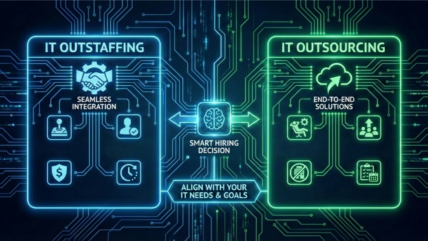
IT outstaffing involves partnering with a third-party firm to hire developers who work remotely but are seamlessly integrated into the client’s existing team structure. The outstaffing company handles recruitment, administrative tasks, and legal paperwork, while the client retains control over project management and team collaboration.
Benefits of IT Outstaffing:
Seamless Integration:
Outstaffed developers become an extension of the client’s team, participating in meetings, utilizing team tools, and reporting directly to project managers.
Control and Oversight:
Clients maintain full control over project management, allowing for closer supervision and alignment with project objectives.
Dedicated Employees:
Just like with traditional hiring, outstaffing guarantees full-time employees whose sole focus in on the IT development needs.
Cost-Effective Solutions:
Outstaffing often proves cost-effective compared to traditional recruitment, with transparent pricing structures and no hidden costs.
Drawbacks of IT Outstaffing:
Time Zone Differences:
Managing remote teams across different time zones can present coordination challenges, impacting communication and project timelines. Nevertheless, when hiring with Coder Staffing, you can expect to meet only the candidates ready to work your business hours.
Dependency on Provider:
The quality of outstaffed developers and the success of the engagement heavily rely on the capabilities and reputation of the outstaffing provider. Thankfully, Coder Staffing’s clients can rely on our extensive database of vetted developers and a high level of involvement in the hiring process.
What is IT Outsourcing?
IT outsourcing involves contracting an external agency to handle specific tasks or projects, often providing end-to-end solutions. Unlike outstaffing, outsourcing entails relinquishing direct control over project execution and team management to the outsourcing agency.
Benefits of IT Outsourcing:
No Management Hassle:
Outsourcing allows businesses to focus on other activities while delegating technical tasks to specialized professionals.
Scalability and Flexibility:
Outsourcing provides scalability, allowing businesses to easily adjust resources based on project requirements without the constraints of permanent hires.
Reduced Overhead:
By outsourcing, businesses can eliminate the need for in-house infrastructure and administrative overhead associated with hiring additional employees.
Drawbacks of IT Outsourcing:
Lack of Control:
Businesses may face loss of control over project management, quality assurance, and timelines, relying heavily on the outsourcing agency’s capabilities.
Communication Challenges:
The lack of direct contact with coders working on the project might hinder effective collaboration and understanding of the specifics of the code vital for future improvement and maintenance.
Differences between Outstaffing and Outsourcing:
Developer Management:
Outstaffing integrates developers into the client’s team structure, enabling direct supervision and collaboration. In contrast, outsourcing delegates project management to the outsourcing agency, reducing client involvement in day-to-day operations.
Quality Control:
Outstaffing provides greater control over the quality of developers’ work through direct management and oversight. Outsourcing requires trust in the outsourcing agency’s vetting processes and project management capabilities.
Time Commitment:
Outstaffing closely mirrors traditional hiring, offering dedicated developers for long-term commitments. Outsourcing allows for more flexibility, with resources allocated based on client’s needs and timelines, and works best on a project basis.
Cost:
Outstaffing typically offers transparent pricing with regular invoicing and no hidden costs, while outsourcing may incur additional fees for project management and overhead expenses.
Partnership Nature:
Outstaffing fosters long-term partnerships focused on collaboration and mutual success, while outsourcing often operates on a project-by-project basis with less emphasis on long-term relationships.
Choosing between IT Outstaffing and Outsourcing
In determining whether to opt for IT outstaffing or outsourcing, several key considerations come into play, guiding businesses toward the most suitable solution for their specific requirements.
IT Needs
Evaluate the nature of your IT needs, including the complexity of projects, ongoing support requirements, and the level of technical expertise necessary for successful execution. If your projects demand continuous collaboration and integration with your existing team, outstaffing may offer the seamless integration required for long-term success.
Project Length
Consider the duration of your projects and the flexibility required in resource allocation. Outstaffing is well-suited for long-term commitments, providing dedicated developers for extended periods, whereas outsourcing offers scalability and flexibility, ideal for shorter-term or project-based engagements.
Technical Expertise
Assess the technical expertise needed for your projects and the availability of specialized skills within your organization. Outstaffing allows for direct control over the recruitment of developers with specific skill sets tailored to your requirements. However, if your team does not have the technical understanding to lead a software development project, letting an outsourcing firm handle it might be the right solution for you.
Budget
Analyze your budget constraints and cost considerations associated with each model. Outstaffing typically offers transparent pricing structures with no hidden costs, making it suitable for businesses seeking cost-effective solutions with long-term commitments. Outsourcing may incur additional fees for project management and overhead expenses.
Conclusion
Choosing between IT outstaffing and outsourcing requires a thoughtful assessment of your project requirements, technical needs, budget constraints, and long-term objectives. While outstaffing offers closer collaboration, control, and cost transparency, outsourcing provides scalability and frees up your time to handle other tasks. By aligning the decision with your specific objectives, you can optimize your IT workforce strategy and achieve successful project outcomes.